
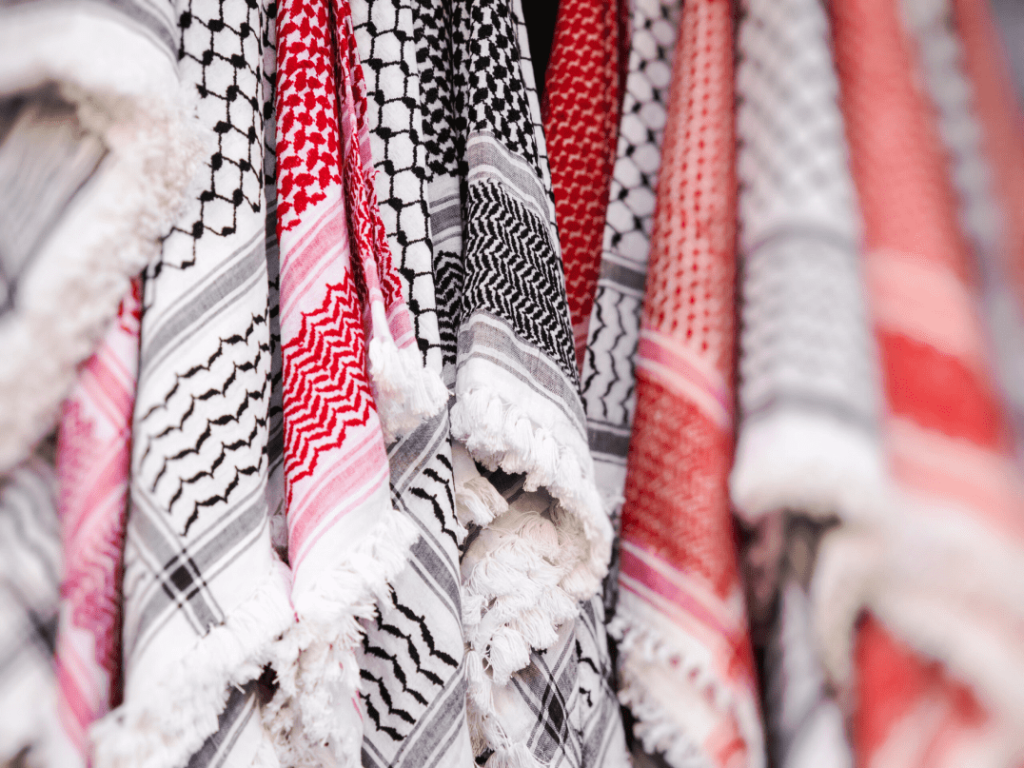


Welcome to our cultural guide! Have you ever wondered what do Arabs wear on their head? From the Gulf to the Levant, the traditional head covering (like the Ghutra, Shemagh, and Keffiyeh) is an essential part of a man’s identity, symbolizing elegance, tradition, and necessary protection from the harsh desert climate. This article will explain the differences between these coverings and answer your questions about why Saudi men cover their heads and the secret behind the red checkered scarf.
What Do Arabs Wear on Their Heads? The Practical and Cultural Reasons
Traditional headwear has deep historical roots in the Arab region, especially in the Gulf Cooperation Council (GCC) states. The reasons for wearing this head covering combine practical necessity with cultural and religious traditions.
Here are the main reasons that answer the question “why do Saudi men cover their heads?”:
- Protection from the Harsh Climate:
- Sun and Heat: The lightweight cotton fabric reflects the sun’s rays and protects the head, face, and neck from high temperatures and sunstroke.
- Sand and Cold: In the desert, the covering is used to shield the face during sandstorms. It also provides necessary warmth during the cold desert nights.
- National Identity and Culture:
- The Ghutra and Shemagh are integral parts of the “National Dress” in Gulf states, alongside the long robe known as the Thobe. Wearing them expresses pride in identity and adherence to tradition.
- Status and Respect:
- In Saudi Arabia, the UAE, and Qatar, wearing the Ghutra or Shemagh neatly and cleanly signifies respect and social standing.
- Adherence to Islamic Teachings:
- Islam encourages modesty (Ihtishām) in clothing for both men and women. The combination of the loose-fitting Thobe and the head covering ensures appropriate modesty.
The Main Head Coverings: Ghutra, Shemagh, and Keffiyeh
In Arabic, there are different names for this head covering depending on the color and the region. They all share the basic structure of a square cotton cloth held in place by the Agal (عقال).
- The White Ghutra (Al-Ghutrah Al-Baydāʾ): A Symbol of Gulf Elegance
The white Ghutra is the most formal style and is predominant in the Arabian Gulf region, especially in Saudi Arabia, the UAE, and Qatar.
| Feature | Simple English Detail |
|---|---|
| Color/Pattern | Plain white (no patterns) |
| Region | Gulf Countries (Saudi Arabia, UAE, Qatar) |
| Cultural Significance | Elegance and formality; worn for official events and formal meetings. |
- The Red and White Shemagh (Al-Shamāgh Al-Aḥmar wal-Abyaḍ): The Famous Saudi Headgear
This addresses your question: why do Saudis wear red checkered headgear? This covering is called the Shemagh, and it is a popular and widespread alternative in Saudi Arabia, Jordan, and Iraq.
| Feature | Simple English Detail |
|---|---|
| Color/Pattern | Red and white checkered (square pattern) |
| Region | Wide circulation (Jordan, Saudi Arabia, Iraq, parts of the Gulf) |
| Cultural Significance | Often considered more practical and casual than the white Ghutra. Carries strong national symbolism in Jordan. |
- The Black and White Keffiyeh (Al-Kūfiyyah Al-Sawdāʾ wal-Bayḍāʾ): A Historical Symbol of the Levant
The Keffiyeh (or Hattah) is the traditional head covering in the Levant region (Bilad al-Sham), including Palestine, Jordan, and Syria.
| Feature | Simple English Detail |
|---|---|
| Color/Pattern | Black and white net-like pattern |
| Region | The Levant (Palestine, Jordan, Syria) |
| Cultural Significance | A historical symbol and an expression of national identity, particularly in Palestine. |
The Agal (Al-ʿIqāl): The Black Holder for the Headwear
It is impossible to wear the Ghutra, Shemagh, or Keffiyeh in the traditional Arab style without the Agal.
- What is the Agal? It is a thick black cord or loop, often made of wool or silk, worn over the headscarf.
- What is its function? Its primary function is to secure the covering to the head, preventing it from falling or shifting due to the wind.
- Significance: It is considered an integral part of the official dress and a symbol of manhood and dignity in traditional Arab culture.
Conclusion: Summary of Headwear Types
| Name of Headwear (in Arabic) | Common Color/Pattern | Most Associated Region |
|---|---|---|
| Ghutra (الغترة) | Plain White | Saudi Arabia & UAE |
| Shemagh (الشماغ) | Red and White Checkered | Jordan & Saudi Arabia |
| Keffiyeh / Hattah (الكوفية) | Black and White Net-like | Palestine & the Levant |
We hope this guide has deepened your understanding of this significant aspect of Arab culture and dress.
To continue exploring the Arabic language and the rich traditions woven into garments like the Ghutra and Shemagh, why not take your learning further?
Download the Kaleela app today! Start your journey to fluency and cultural discovery, so the next time you see this traditional attire, you’ll understand the history and meaning behind every thread.